

The short answer
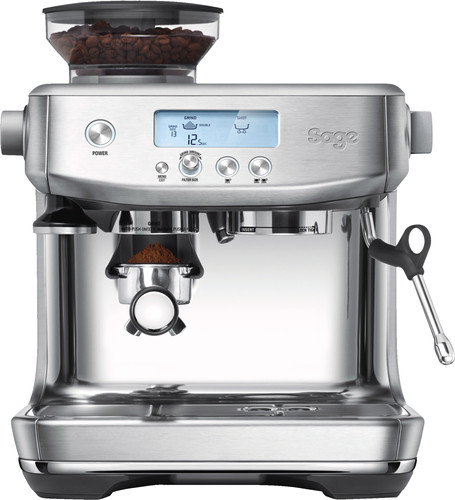
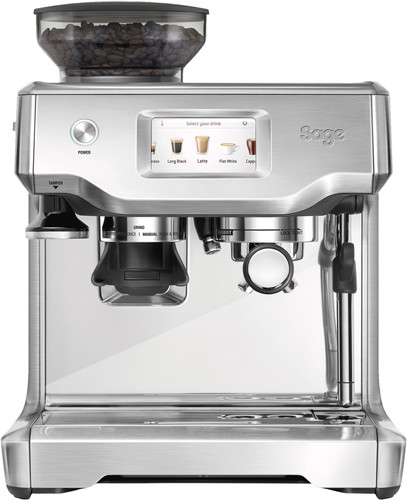
For the espresso itself it makes little difference. The Sage the Barista Pro has the same grinder with 30 settings, the same 3-second heat-up time and the same portafilter as the Touch, and costs €104 less. The Sage the Barista Touch takes the milk frothing off your hands and guides you through every cup via the touchscreen. Grinding, tamping and locking in the portafilter you do yourself on both.
Choose the Barista Pro if…
- you mainly drink espresso or americano and froth little milk;
- you want to learn to steam milk yourself: testers recommend the manual wand for latte art;
- you would rather spend €104 on good beans or a small set of scales;
- you want a lighter machine: 9.1 kg versus 12.2 kg according to Coffeeness.
Choose the Barista Touch if…
- you almost always drink cappuccino or latte and do not feel like learning to steam milk;
- several people use the machine: you can save up to 8 recipes of your own with a name;
- you want to be guided step by step through brewing on a touchscreen;
- you are short of space: according to Sage the Touch is over 3 cm narrower.

Do the sums with me: for €104 extra you do not get better espresso. The grinder, the pump and the heating element are the same. You are buying convenience with the milk and a screen that thinks along with you. That is not nonsense: steaming milk well takes weeks of practice, and the Touch does it with one tap. But it remains a machine where you grind, tamp and dial in yourself. If you mainly drink it black, or want to learn the craft, the Barista Pro is the sensible buy. If the whole household drinks cappuccino, the Touch is worth its extra cost at Coolblue. At bol the difference is over two hundred euros, and then it becomes a different story.
Specs side by side
| Barista Pro | Barista Touch | |
|---|---|---|
| Controls | LCD screen with buttons and dial | Colour touchscreen with coffee menu |
| Milk frothing | Manual steam wand | Automatic, or manual if you prefer |
| Milk foam settings (Sage's figure) | None, you do it by feel | 40 to 75 °C and 8 foam levels |
| Save your own recipes | No | Up to 8 |
| Heat-up time (Sage's figure) | 3 seconds (ThermoJet) | 3 seconds (ThermoJet) |
| Grinder | Conical burr, 30 settings | Conical burr, 30 settings |
| Pump (Sage's figure) | 15 bar, extraction at 9 bar | 15 bar, extraction at 9 bar |
| Portafilter | 54 mm | 54 mm |
| Water tank | 2 litres | 2 litres |
| Bean hopper | 250 grams | 250 grams |
| Dimensions w x d x h (Sage's figure) | 35.4 x 34.3 x 40.6 cm | 32 x 32 x 41 cm |
| Weight (according to Coffeeness) | 9.1 kg | 12.2 kg |
| Price | from €595 | from €699 |
Highlighted in green = better on that point. The links below go to the brushed stainless steel version (SES878BSS and SES880BSS). The bean hopper is 250 grams according to Sage's manual and Expert Reviews; Coffeeness says 230 grams. Sage itself does not state a weight, that figure comes from Coffeeness's reviews. Prices as of 17 November 2026.
Benchmarks
There are few independent measurements in which both machines were tested in exactly the same way. So Benny only shows figures that can genuinely be put side by side: the width according to Sage and the weight according to Coffeeness's reviews. For weight and width, lower is better if you are short of space.
Source: Coffeeness: Breville Barista Pro review, Coffeeness: Breville Barista Touch review
Milk foam: this is where the real difference is
With the Barista Touch you put the jug under the steam wand and tap the screen. A sensor in the drip tray grille measures the temperature and the wand stops by itself. According to Sage you choose a temperature between 40 and 75 degrees and one of 8 foam levels, from thin for a latte to airy for a cappuccino. Expert Reviews calls the result almost perfect microfoam. Home Grounds gives the milk foam 4 out of 5 and notes that the wand adds air by itself, which is less ideal for latte art.
With the Barista Pro you steam by hand. You have to learn that, but the machine helps: the steam wand has four holes and steam is there within a few seconds. Coffee Blog got 200 ml of milk to 60 degrees in 47 seconds. On the Touch the same tester measured about 45 seconds for 170 ml. So the automatic version is not faster, but it is easier. If you would still like to steam by hand on the Touch, you can do that too.
Controls: touchscreen versus buttons
The Touch's touchscreen shows a menu including espresso, americano, latte, flat white and cappuccino. For each drink you adjust the grind time, amount of coffee and milk, and you save up to 8 recipes of your own with a name. Handy if one person wants a strong flat white and the other a large latte. Home Grounds gives ease of use 5 out of 5. Coffeeness finds the screen a little less responsive than a phone.
The Barista Pro has a monochrome LCD screen with a grind timer and a shot timer. You operate it with buttons and a dial. That is less pretty, but you see exactly what you need to dial in a shot. Note: neither is a bean-to-cup machine. Coffee Blog warns that people buy the Touch expecting it to do everything itself. Grinding, tamping and locking in the portafilter remains manual work.
Espresso, grinder and the model above
For the coffee itself they are twins. Both have a conical burr grinder with 30 settings, a 54 mm portafilter and the ThermoJet element that according to Sage is hot in 3 seconds. Coffeeness adds that the group head and the cups are only properly warm after flushing through a few times. The criticism is the same too: testers sometimes find the grinder's steps too coarse for very precise dialling in, and neither has a pressure gauge. They are machines with a single heating element, so brewing coffee and steaming milk happen one after the other.
Above the Touch there is now the Barista Touch Impress. It also helps with dosing and tamping using a lever, has milk settings for oat, soy and almond and can cold brew. TechRadar is very positive about it. It costs around €1,000 at bol. If it is mainly the tamping and dialling in that you dread, that is the logical step. For anyone who only wants help with the milk, the regular Touch will do.
Prices
Below are direct links to the product pages at Dutch online shops. Prices are updated automatically as soon as the shop changes them in its product feed. Check the version: both machines also come in other colours, and the Barista Touch Impress is a different, more expensive model.
If you buy through these links we may earn a commission, at no extra cost to you. That does not change the verdict. How we make money.
 FAQ
What is the difference between the Sage Barista Pro and the Barista Touch?
The controls and the milk. The Touch has a touchscreen with coffee menu, 8 slots for your own recipes and a steam wand that froths automatically. The Pro has an LCD screen with buttons and a manual steam wand. Grinder, heat-up time and portafilter are the same.
Does the Barista Touch make better espresso than the Barista Pro?
There is no indication of that. Both have the same grinder with 30 settings, a 15 bar pump and the ThermoJet element. Home Grounds calls the coffee quality equivalent. The Touch is mainly easier to use.
Is the Barista Touch a bean-to-cup machine?
No. You grind into the portafilter, tamp the coffee yourself and lock the portafilter into the machine. Only the milk foam is automatic. Anyone who also wants help with dosing and tamping ends up at the Barista Touch Impress.
How quickly are they ready to use?
Sage quotes a 3-second heat-up time for both. Coffee Blog measured about 5 seconds on the Touch. After that, steam is there within a few moments. The group head and your cups do need a little longer to warm up.
Is there a newer model than the Barista Touch?
Yes, the Barista Touch Impress. It adds help with dosing and tamping, plus milk settings for plant-based milk and cold coffee. It costs around €1,000 at bol. The regular Touch and the Pro are still on sale as normal.
Sources
Benny does not test in a lab himself. Specs come from the manufacturer, measurements from independent testers. These are the sources for this comparison:
- Sage: the Barista Pro
- Sage: the Barista Touch
- Coffeeness: Breville Barista Pro review
- Coffeeness: Breville Barista Touch review
- Coffee Blog: Sage Barista Touch en Touch Impress review
- Expert Reviews: Sage Barista Pro review
- Home Grounds: Breville Barista Touch review
Spotted something out of date? Let us know and we'll fix it.