


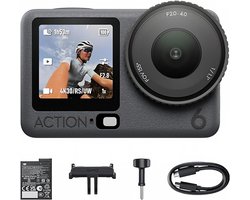
The short answer
The price difference is small: €22 in the GoPro's favour. So the choice depends on what you film. The DJI Osmo Action 6 has a 1/1.1-inch sensor versus 1/1.9-inch on the GoPro, and according to Amateur Photographer and Engadget clearly wins in low light. The GoPro HERO13 Black films in 5.3K at 60 frames per second, where the DJI stops at 4K. That gives a sharper picture in daylight and more room to crop.
Choose the HERO13 Black if…
- you mainly film in daylight and want the highest resolution;
- you want to be able to crop afterwards without dropping below 4K;
- you already have GoPro mounts, lens mods or batteries for the HERO13;
- you want GPS data such as speed and route with your video.
Choose the Osmo Action 6 if…
- you often film at dusk, in the woods or indoors;
- you want to dive deep or snorkel without an extra housing: 20 metres versus 10;
- you don't want to depend on a memory card: it has 50 GB of storage built in;
- you also make vertical video in 4K for social media.

On paper the GoPro wins on resolution and the DJI on almost everything else. In practice it is mainly the light that counts. If you film on a sunny piste or on the water, 5.3K gets you the sharpest picture out of the GoPro. As soon as the sun goes down, the DJI pulls ahead. In doubt? Then the Osmo Action 6 is the safest choice, because it performs well in more situations.
Specs side by side
| HERO13 Black | Osmo Action 6 | |
|---|---|---|
| Sensor | 1/1.9-inch | 1/1.1-inch |
| Aperture | f/2.5 (fixed) | f/2.0 to f/4.0 (variable) |
| Highest video resolution | 5.3K at 60 frames per second | 4K at 120 frames per second |
| Photos | 27 megapixels | 38 megapixels |
| Waterproof without housing | 10 metres | 20 metres |
| Built-in storage | None (microSD only) | 50 GB and microSD |
| Battery | 1,900 mAh | 1,950 mAh |
| Rear screen | 2.27-inch | 2.5-inch |
| Tripod mount in the body | Yes | No, via adapter |
| Weight | 159 grams | 149 grams |
| Price | €376.99 | €399 (Standard Combo) |
Highlighted in green = better on that point. Specifications according to Amateur Photographer, Engadget and Expert Reviews, based on the figures from GoPro and DJI.
Benchmarks
The first chart comes from a single test: Amateur Photographer had both cameras film continuously in Full HD at 30 frames per second. The second chart is the manufacturers' own figure, as reported by Expert Reviews and Engadget. Longer is better.
Source: Amateur Photographer: DJI Osmo Action 6 vs GoPro Hero 13 Black
Source: Engadget: DJI Osmo Action 6 review, Expert Reviews: GoPro Hero 13 Black review
Image quality in daylight and in low light
The GoPro reaches 5,312 by 2,988 pixels at 60 frames per second. Engadget therefore calls the HERO13 the better camera for most daylight footage: you can downscale the image to extra-sharp 4K, or crop heavily. The Osmo Action 6 stops at 4K, but has a clearly bigger sensor. Amateur Photographer saw richer colours and more dynamic range from the DJI, and calls the difference in low light literally night and day. Expert Reviews already noticed noise from the GoPro under trees and indoors.
The DJI's variable aperture runs from f/2.0 to f/4.0. According to Engadget that is a first for an action cam. Note: f/2.0 only works in automatic mode, not as a fixed setting.
Battery, storage and accessories
In Amateur Photographer's continuous test both cameras lasted about 2 hours and 40 minutes in Full HD. In mixed use over a day the DJI did consistently have more battery left: 89 per cent versus 77 per cent, later 78 versus 60 per cent. The GoPro also charges slowly: Expert Reviews measured over two hours for a full battery.
The GoPro has the strongest line of accessories. The HB lens mods (macro, ultra-wide, anamorphic) are recognised by the camera, and the settings then adjust automatically. The DJI has 50 GB of storage on board, handy if your card is full or forgotten. A macro lens and a wide-angle lens are available for the DJI.
Prices
These are the versions from our product feed, with a direct link to the product page at Dutch online shops. Prices are updated automatically as soon as the shop changes them. Always check the current price at the shop.
If you buy through these links we may earn a commission, at no extra cost to you. That does not change the verdict. How we make money.
 FAQ
What is the biggest difference between the GoPro HERO13 Black and the DJI Osmo Action 6?
The GoPro films at a higher resolution (5.3K versus 4K). The DJI has a bigger sensor and a variable aperture, and is therefore better in low light. The DJI is also waterproof to a greater depth and has built-in storage.
Does the DJI Osmo Action 6 film in 8K?
No. According to Engadget and Amateur Photographer, 4K is the maximum for video, at up to 120 frames per second. Some online shop titles say 8K; don't count on that.
Which action cam is better for winter sports?
On a sunny piste the GoPro delivers the sharpest picture with 5.3K. If you also film in overcast conditions, at dusk or in the hut, the DJI Osmo Action 6 is the better choice.
Which lasts longer on a battery?
In a continuous test by Amateur Photographer there was no difference: about 2 hours and 40 minutes in Full HD. In mixed use the DJI had more battery left.
Sources
Benny does not test in a lab himself. Specs come from the manufacturer, measurements from independent testers. These are the sources for this comparison:
- Amateur Photographer: DJI Osmo Action 6 vs GoPro Hero 13 Black
- Engadget: DJI Osmo Action 6 review
- Expert Reviews: GoPro Hero 13 Black review
Spotted something out of date? Let us know and we'll fix it.