

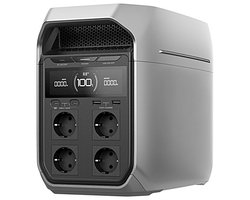

The short answer
The Anker SOLIX C1000 Gen 2 is €280 cheaper, 1.2 kilos lighter and delivers 2,000 watts versus 1,800 watts. For camping or an evening without power, that is the logical choice. The EcoFlow DELTA 3 Plus has one big advantage: you can connect extra batteries to it, up to 5 kWh in total. The Anker cannot do that. If you want more capacity later, with Anker you are stuck with buying a new unit.
Choose the DELTA 3 Plus if…
- you want to be able to expand later with an extra battery;
- you see the power station as backup power for the home and want room to grow;
- you already have EcoFlow solar panels or batteries;
- four sockets are enough for you.
Choose the SOLIX C1000 Gen 2 if…
- 1 kWh is enough for you and will stay that way;
- you lift it often: 11.3 kilos versus 12.5 kilos;
- you connect heavier appliances, up to 2,000 watts;
- you charge a lot via USB-C: three ports at up to 140 watts;
- you want to spend as little as possible.

Same size, full just as fast, lasting just as long: 4,000 charge cycles for both. The difference is in the future. If you are sure 1 kWh is enough, with the EcoFlow you pay €280 for an option you will not use. If you are wondering whether you will ever want to keep the fridge going for a day, then expandable is precisely the point. With the EcoFlow, mind the noise: T3 heard the fans kick in often, even without a heavy load.
Specs side by side
| DELTA 3 Plus | SOLIX C1000 Gen 2 | |
|---|---|---|
| Capacity | 1,024 Wh (LFP) | 1,024 Wh (LFP) |
| Socket power output | 1,800 watts | 2,000 watts |
| Peak power | 3,600 watts | 3,000 watts |
| Expandable | Yes, up to 5 kWh | No |
| Charging from the mains | 56 minutes (1,500 watts) | 49 minutes (1,600 watts, UltraFast) |
| Solar panels | up to 500 watts | up to 600 watts |
| Backup power (UPS) | switches over within 10 ms | switches over in 10 ms |
| Sockets | 4 | 5 |
| USB-C | 2 ports, up to 140 watts | 3 ports, up to 140 watts |
| USB-A | 2 ports | 1 port |
| Battery lifespan | 4,000 cycles to 80% | 4,000 cycles to 80% |
| Weight | 12.5 kg | 11.3 kg |
| Price | €779 | €499 |
Highlighted in green = better on that point. Manufacturer's figures. EcoFlow: according to StorageReview, T3 and the product page at bol (European version with four sockets). Anker: according to Anker SOLIX and Notebookcheck (European version).
Benchmarks
The charging time is the manufacturers' figure. The usable capacity has been measured, but by two different testers each with their own method. So take the comparison of those two numbers with a pinch of salt.
Source: StorageReview: EcoFlow DELTA 3 Plus review, Anker SOLIX: C1000 Gen 2, specificaties
Source: StorageReview: EcoFlow DELTA 3 Plus review, Notebookcheck: Anker Solix C1000 Gen 2 review
Power and capacity
The label says 1,024 Wh on both. In practice you never quite get that, because the inverter uses power itself too. StorageReview got 910 Wh out of the EcoFlow. Notebookcheck arrived at about 850 Wh for the Anker at a load of 250 watts. Those are different tests, so do not draw a firm conclusion from them. With both, reckon on roughly 85 per cent of the stated capacity.
The Anker delivers 2,000 watts continuously, the EcoFlow 1,800 watts. For a kettle or a small air fryer that is enough with either. According to the product page at bol, the EcoFlow has an X-Boost mode of up to 2,400 watts for a single appliance. According to StorageReview you can expand the EcoFlow to 5 kWh with extra batteries.
Charging, noise and use
Both are full in under an hour. Anker states 49 minutes, but only if you switch on UltraFast charging in the app. Without that mode Notebookcheck measured just under 55 minutes. EcoFlow states 56 minutes. From solar panels the Anker accepts up to 600 watts, the EcoFlow up to 500 watts.
Noise is something to watch. Notebookcheck measured about 45 dB at one metre on the Anker during fast charging or under heavy load; under light load it is almost silent. With the EcoFlow, T3 noticed that the fans kicked in almost continuously as soon as a port was switched on, even without a load. For use as silent backup power next to your desk, T3 considered that a drawback. Anker has dropped some things on the Gen 2, though: the light is gone, and so is the option to connect an extra battery.
Prices
These are the versions from our product feed, with a direct link to the product page at Dutch online shops. Prices are updated automatically as soon as the shop changes them. Always check the current price at the shop.
If you buy through these links we may earn a commission, at no extra cost to you. That does not change the verdict. How we make money.
 FAQ
What is the difference between the EcoFlow DELTA 3 Plus and the Anker SOLIX C1000 Gen 2?
Both have 1,024 Wh. The Anker is lighter, delivers 2,000 watts and is cheaper. The EcoFlow delivers 1,800 watts, but can be expanded to 5 kWh with extra batteries.
How long can a fridge run on 1,024 Wh?
That depends on your fridge. Reckon on 850 to 900 Wh that you can actually use. Divide that by your fridge's average consumption in watts and you have the number of hours.
Can I expand the Anker SOLIX C1000 Gen 2 with an extra battery?
No. According to Anker and Notebookcheck, the Gen 2 no longer has a connection for an expansion battery. The first C1000 did have one.
Are these power stations suitable as backup power?
Yes, both have a UPS function that, according to the manufacturer, switches over within 10 milliseconds. StorageReview measured just over 8 milliseconds on the EcoFlow.
Sources
Benny does not test in a lab himself. Specs come from the manufacturer, measurements from independent testers. These are the sources for this comparison:
- StorageReview: EcoFlow DELTA 3 Plus review
- T3: EcoFlow DELTA 3 Plus review
- Anker SOLIX: C1000 Gen 2, specificaties
- Notebookcheck: Anker Solix C1000 Gen 2 review
Spotted something out of date? Let us know and we'll fix it.